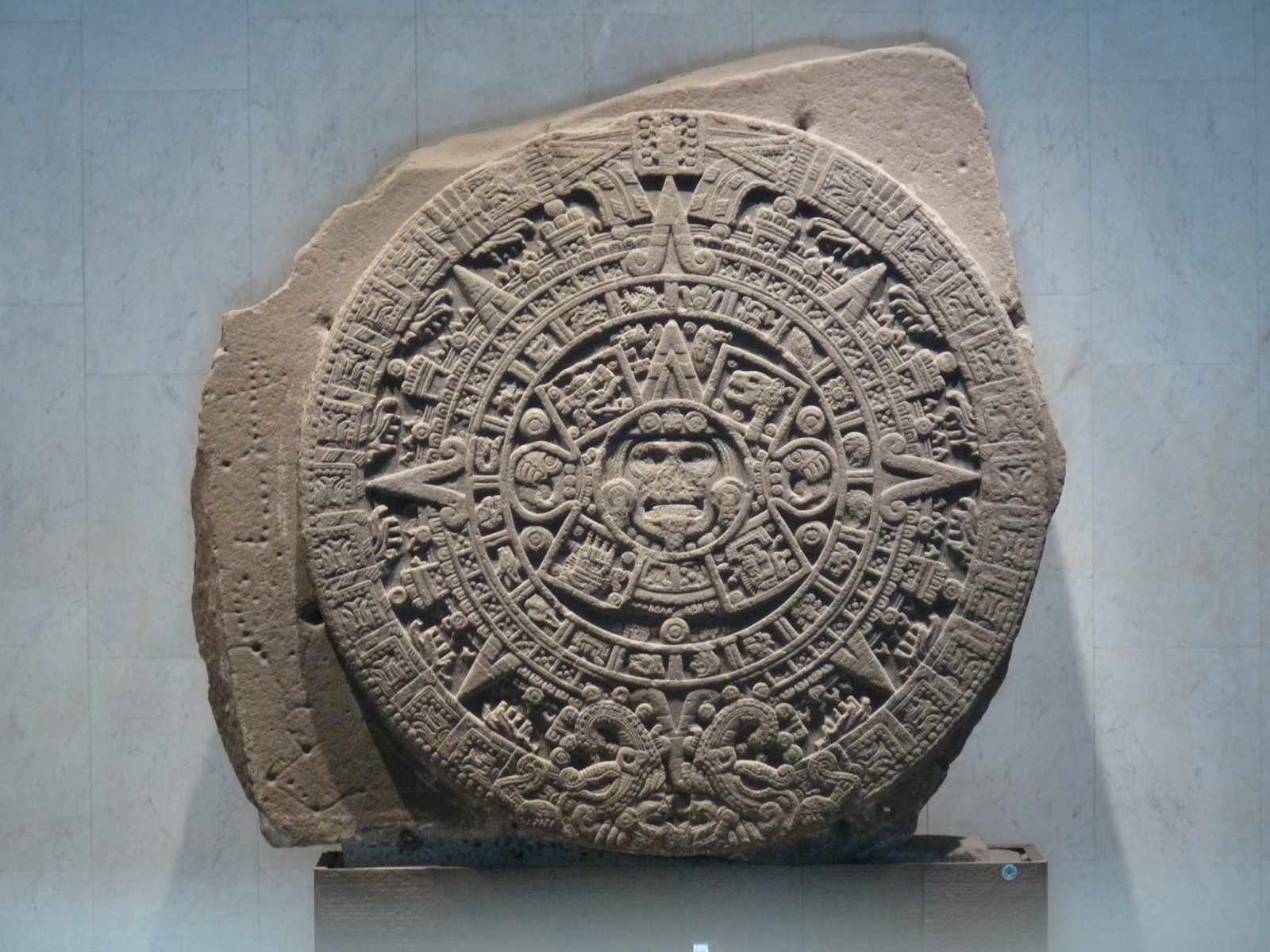
Five worlds have been created and destroyed. The current one—the Fifth Sun, Nahui Ollin—was born at Teotihuacan when the gods threw themselves into a fire so the sun would move. It will end in earthquakes. This is not prophecy in the Western sense. It is cosmological grammar: creation requires sacrifice, existence is cyclical, and every age carries the memory of its predecessors’ destruction.
The Mesoamerican eschatological tradition spans from the Aztec altiplano to the Maya lowlands to the Andean highlands—civilizations separated by thousands of miles but connected by a shared intuition: that the cosmos iterates. Each iteration is destroyed not by divine anger but by the exhaustion of its sustaining principle. The Fifth Sun is sustained by movement (ollin). When movement ceases, the earth will shake apart.
For five centuries, this tradition has been filtered through European lenses—most damagingly, the fabrication that the Aztecs mistook Hernán Cortés for the returning Quetzalcoatl. Camilla Townsend’s “Burying the White Gods” (AHR, 2003) and Matthew Restall’s Seven Myths of the Spanish Conquest (2003) dismantled this narrative as a post-conquest invention.1 The tradition deserves to be read on its own terms.
ORIGINS: THE FEATHERED SERPENT AND THE SERPENT WOMAN
Quetzalcoatl (Nahuatl: Quetzalcōātl, “Feathered Serpent”) is not a single deity but a layered figure: cosmogonic creator, wind god (Ēhecatl), and historical priest-king of Tollan (Ce Ācatl Topiltzin Quetzalcoatl). In the creation narrative preserved in the Leyenda de los Soles, Quetzalcoatl descends to Mictlan—the underworld—to retrieve the bones of previous humanity. He is challenged by Mictlantecuhtli, lord of the dead, falls into a pit, and the bones shatter. Cihuacōātl (“Serpent Woman”) grinds the broken bones on a stone. Quetzalcoatl bleeds onto the meal. Humanity is remade from bone dust and divine blood.2
Coatlicue (“Serpent Skirt”) is the earth mother—her monumental basalt statue in the Museo Nacional de Antropología depicts a figure with a necklace of severed hands and hearts, a skirt of intertwined serpents, and clawed feet. For centuries this was read as evidence of Aztec barbarism. Cecelia Klein’s 2008 reinterpretation in Ethnohistory argues the statue depicts not victimization but self-sacrifice during creation—the goddess dismembered so the world could exist. The parallel to Tiamat’s dismemberment in the Enūma Eliš is structural, not borrowed: two independent traditions encoding the same cosmogonic act.3
“In tōnātiuh ōmpa huālquīza.”—“The sun rises from there.”
— Codex Chimalpopoca, 16th c.
THE FIVE SUNS
The Five Suns cosmology, preserved in the Leyenda de los Soles and the Historia de los Mexicanos por sus Pinturas, describes five cosmological ages, each governed by a different deity and destroyed by a different catastrophe. The pattern is not linear decline—it is iteration. Each destruction is followed by a new creation attempt, incorporating lessons from the previous failure.4
| Sun | Nahuatl Name | Destruction | Ruler |
|---|---|---|---|
| First | Nahui Ocelotl (4 Jaguar) | Jaguars devour humanity | Tezcatlipoca |
| Second | Nahui Ehēcatl (4 Wind) | Hurricanes | Quetzalcoatl |
| Third | Nahui Quiahuitl (4 Rain) | Rain of fire | Tlaloc |
| Fourth | Nahui Atl (4 Water) | Great flood | Chalchiuhtlicue |
| Fifth | Nahui Ollin (4 Movement) | Earthquakes (in progress) | Tonatiuh |
The Fifth Sun was created at Teotihuacan. In the foundational narrative, two gods—Nanahuatzin (a humble, poxmarked deity) and Tecciztecatl (a wealthy, proud one)—were asked to throw themselves into a fire to become the sun. Tecciztecatl hesitated four times. Nanahuatzin leapt without hesitation and became the sun. Tecciztecatl followed and became the moon—but the other gods threw a rabbit at his face to dim his light, which is why the moon bears the mark of a rabbit.5 The remaining gods then sacrificed themselves so the sun would move. This is the theological foundation of Aztec offering theology: the cosmos requires sacrifice not because the gods are cruel, but because the gods themselves established the precedent.
The Five Suns are not a prediction. They are a record of cosmological experiments. The current age is not doomed by prophecy but sustained by practice—and will end when the sustaining practice fails.
THE POPOL VUH: CREATION IN K’ICHE’ MAYA
The Popol Vuh—the K’iche’ Maya creation narrative, preserved in the Newberry Library manuscript and most recently translated by Allen Christenson (2003)—tells a structurally parallel but distinct story. The gods attempt to create humanity three times: from mud (it dissolves), from wood (it lacks soul and is destroyed in a flood), and finally from maize dough (it succeeds). The wooden people’s failure is instructive: they had form but no consciousness. They could not remember their makers. They could not keep the days.6
The centerpiece of the Popol Vuh is the Hero Twins—Hunahpu and Xbalanque—who descend to Xibalba (the underworld) to face the Lords of Death. They are killed, ground to bone meal, thrown into a river—and regenerate. They return in disguise as traveling performers, defeating the Lords through cunning rather than force. They rise as the sun and moon. The descent-and-return pattern echoes across traditions: Quetzalcoatl in Mictlan, Inanna in Kur, Orpheus in Hades, Osiris in the Duat.7
“Are u xe’ ojer tzij”—“This is the beginning of the ancient word.”
— Popol Vuh, opening line. Christenson (2003).
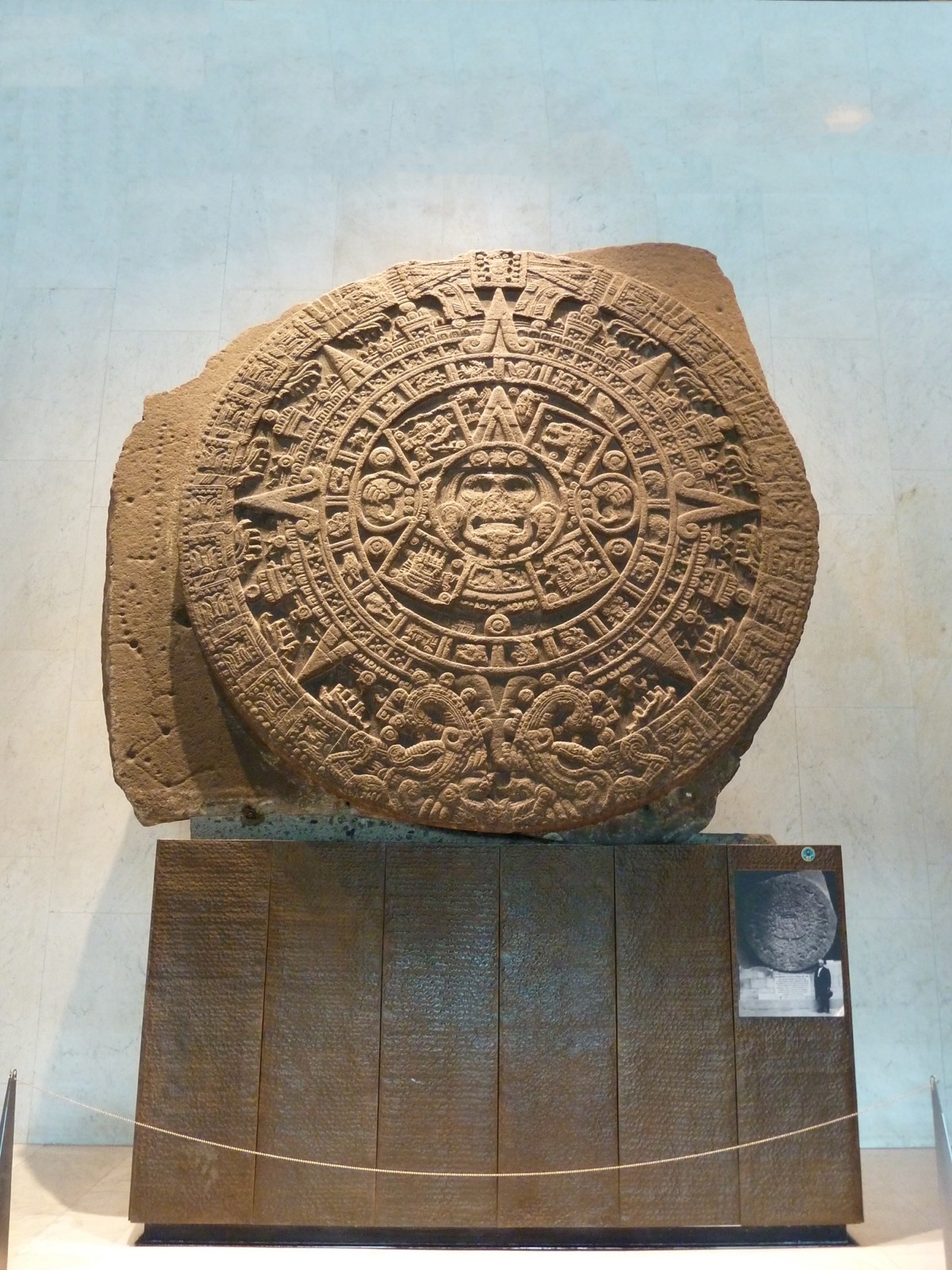
PIEDRA DEL SOL
Basalt, c. 1502-1521 CE — the Five Suns at the center of Aztec cosmology
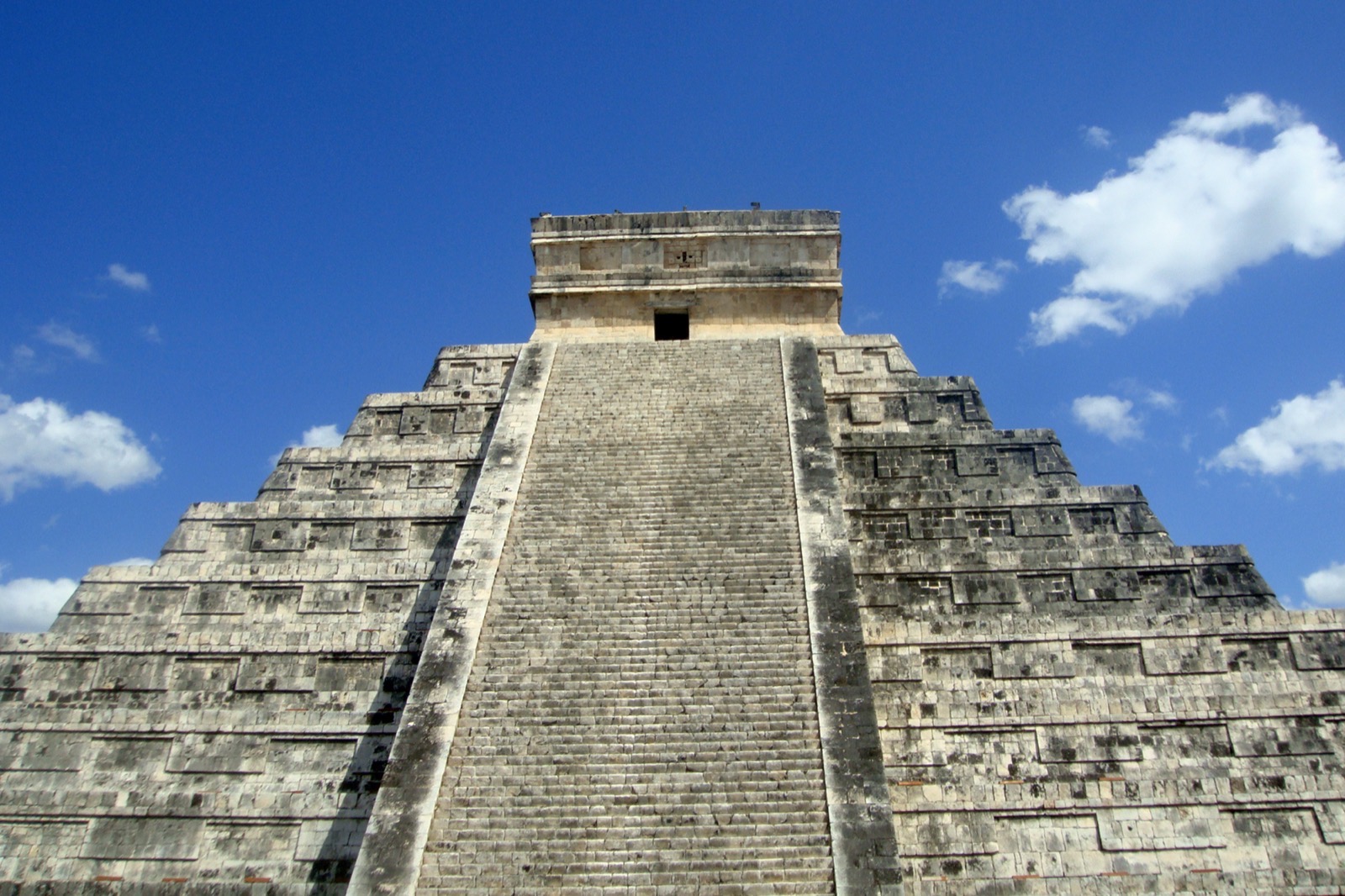
KUKULKAN DESCENDS
El Castillo, Chichen Itza — equinox serpent shadow, 365 steps
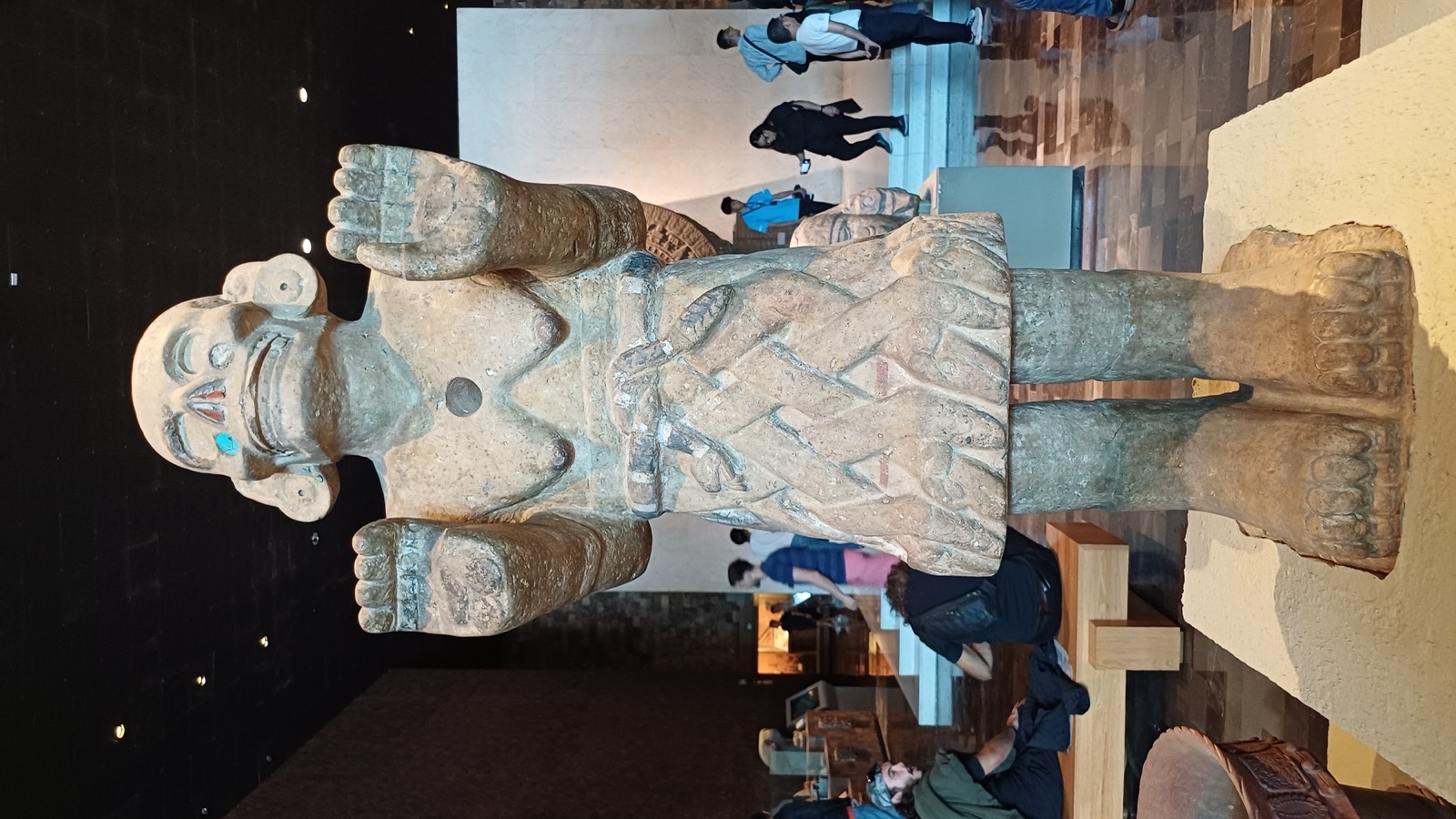
COATLICUE
Basalt, c. 1500 CE — Museo Nacional de Antropología, Mexico City
ANDEAN ESCHATOLOGY: PACHACUTI AND THE RETURN OF THE INCA
South of the Mesoamerican world, the Andean tradition encodes its own eschatological framework. Pachacuti (Quechua: pachakutiy, from pacha “world/time” + kutiy “to turn/return”) means cosmic reversal—each age ends in cataclysm and regenerates. The Inca ruler Pachacuti took this as his throne name, claiming to inaugurate a new cosmic era. The concept predates the Inca empire, reaching back through Wari, Tiwanaku, and Chavín civilizations.8
After the Spanish execution of Tupac Amaru I in 1572, the Inkarri myth crystallized: the severed head of the last Inca, buried somewhere in Cusco, is slowly reassembling its body underground. When the body is complete, pachacuti occurs—the colonial world is overturned, the mountains reclaim the plains, and the Inca order is restored. Nathan Wachtel’s Vision of the Vanquished (1977) documents this as indigenous resistance theology, not passive fatalism.9
The Taki Onqoy movement (c. 1564–1572) was explicitly eschatological. Practitioners were “seized” by the huacas—the sacred forces of the land—and prophesied that the huacas would defeat the Christian god. The Spanish documented and suppressed it precisely because they recognized it as a counter-theology, not a folk superstition. The Eagle and Condor prophecy circulates today among Quechua communities: Eagle (North, intellect, technology) and Condor (South, heart, nature) will fly together in the Fifth Pachakuti, signaling hemispheric reunion.10
“Pachakutiy”—“World reversal.” The earth turns over. What was below rises.
— Quechua, from pacha (world/time) + kutiy (to turn/return).
“Then they sacrificed themselves, all of the gods, there at Teotihuacan. And only thus did the sun begin to move.Leyenda de los Soles — Codex Chimalpopoca, 16th c.
CONTEMPORARY SIGNAL
In 2008 and 2009, Ecuador and Bolivia enshrined sumak kawsay (Quechua: Vivir Bien, “living well”) in their constitutions—the concept of living in harmony with Pachamama translated into constitutional law. This is not symbolism. Bolivia’s Ley de Derechos de la Madre Tierra (2010) grants legal personhood to the earth. The philosophical foundation is Andean: Pachamama is not a metaphor but a legal subject.11
The EZLN Zapatista movement in Chiapas, Mexico, operates on a principle drawn from Mesoamerican pluriverse cosmology: “Un mundo donde quepan muchos mundos”—“A world where many worlds fit.” This is not postmodern relativism. It is the cosmological grammar of traditions that have always understood time as cyclical and reality as layered—the Three Worlds of Andean cosmology (uku pacha, kay pacha, hanan pacha) coexisting, the Popol Vuh’s multiple creation attempts succeeding through iteration rather than replacement.12
Rosalyn Bold’s Indigenous Perceptions of the End of the World (Palgrave, 2019)—the first academic volume on indigenous Latin American perspectives on climate catastrophe—reframes the conversation: these traditions do not need to be “rescued” from the margins. They are diagnostic systems that have been modeling civilizational collapse for millennia.13
The Five Suns framework applies to the current war with uncomfortable precision. A civilization that sustains itself through consumption of others’ resources—oil from the Strait of Hormuz, rare earths from contested supply chains, food from destabilized markets—is, in the Aztec diagnosis, a Sun sustained by sacrifice it has not acknowledged. Mexico’s “active neutrality” in the Iran-US conflict, rooted in the Estrada Doctrine of non-intervention, represents a position the Five Suns tradition would recognize: the refusal to feed one empire’s fire at the cost of another’s world. The cross-tradition serpent thread—Quetzalcoatl (Mesoamerican), Amaru (Andean), Nüwa (Chinese), the Antediluvian serpent-goddess—encodes a shared memory of creative power that was never, in these traditions, turned into a monster.1415
SOURCES
- Townsend, C. “Burying the White Gods: New Perspectives on the Conquest of Mexico.” American Historical Review 108.3 (2003): 659–687. Restall, M. Seven Myths of the Spanish Conquest (Oxford UP, 2003/2021).
- López Austin, A. Tamoanchan, Tlalocan: Places of Mist (UT Press, 1994). Quetzalcoatl’s descent to Mictlan: Leyenda de los Soles, Codex Chimalpopoca.
- Klein, C.F. “A New Interpretation of the Aztec Statue Called Coatlicue.” Ethnohistory 55.2 (2008): 229–250. Dexter, M.R. “The Monstrous Goddess.” J. Archaeomythology 7 (2011).
- Florescano, E. The Myth of Quetzalcoatl (Johns Hopkins UP, 1999). Memory, Myth, and Time in Mexico (UT Press, 1994).
- Carrasco, D. Quetzalcoatl and the Irony of Empire (U. Colorado Press, 2000). Nanahuatzin narrative: Leyenda de los Soles.
- Christenson, A.J. Popol Vuh: The Sacred Book of the Maya (U. Oklahoma Press, 2003). Translated from the Newberry Library manuscript.
- Tedlock, D. Popol Vuh: The Definitive Edition of the Maya Book of the Dawn of Life and the Glories of Gods and Kings (Simon & Schuster, 1996).
- Wachtel, N. “Return of the Inca.” Histórica (2024). Pachacuti as cosmic reversal: pre-Inca Andean concept.
- Wachtel, N. The Vision of the Vanquished: The Spanish Conquest of Peru Through Indian Eyes (Harvester Press, 1977). Inkarri myth documented across Quechua communities.
- Stern, S. (ed.) Resistance, Rebellion, and Consciousness in the Andean Peasant World (U. Wisconsin Press, 1987). Taki Onqoy: Molina, C. de. Relación de las fábulas y ritos de los Incas (1573).
- Estado Plurinacional de Bolivia, Ley de Derechos de la Madre Tierra, Ley Nº 071 (2010). Ecuador, Constitución de la República, Art. 71–74 (2008).
- Purcell, S. The Outward Path: Wisdom of the Aztecs (W.W. Norton, 2025). EZLN, Cuarta Declaración de la Selva Lacandona (1996).
- Bold, R. (ed.) Indigenous Perceptions of the End of the World: Creating a Cosmopolitics of Change (Palgrave Macmillan, 2019).
- Taube, K. Selected Works (Mesoweb, 2018). Stuart, D. King and Cosmos (Mesoweb, 2021). López Austin, A. The Human Body and Ideology (U. Utah Press, 1988).
- Charlesworth, J.H. The Good and Evil Serpent (Yale UP, 2010). Dailey, C.W. “The Serpent Symbol in Tradition.” PhD diss., U. North Texas (2020).