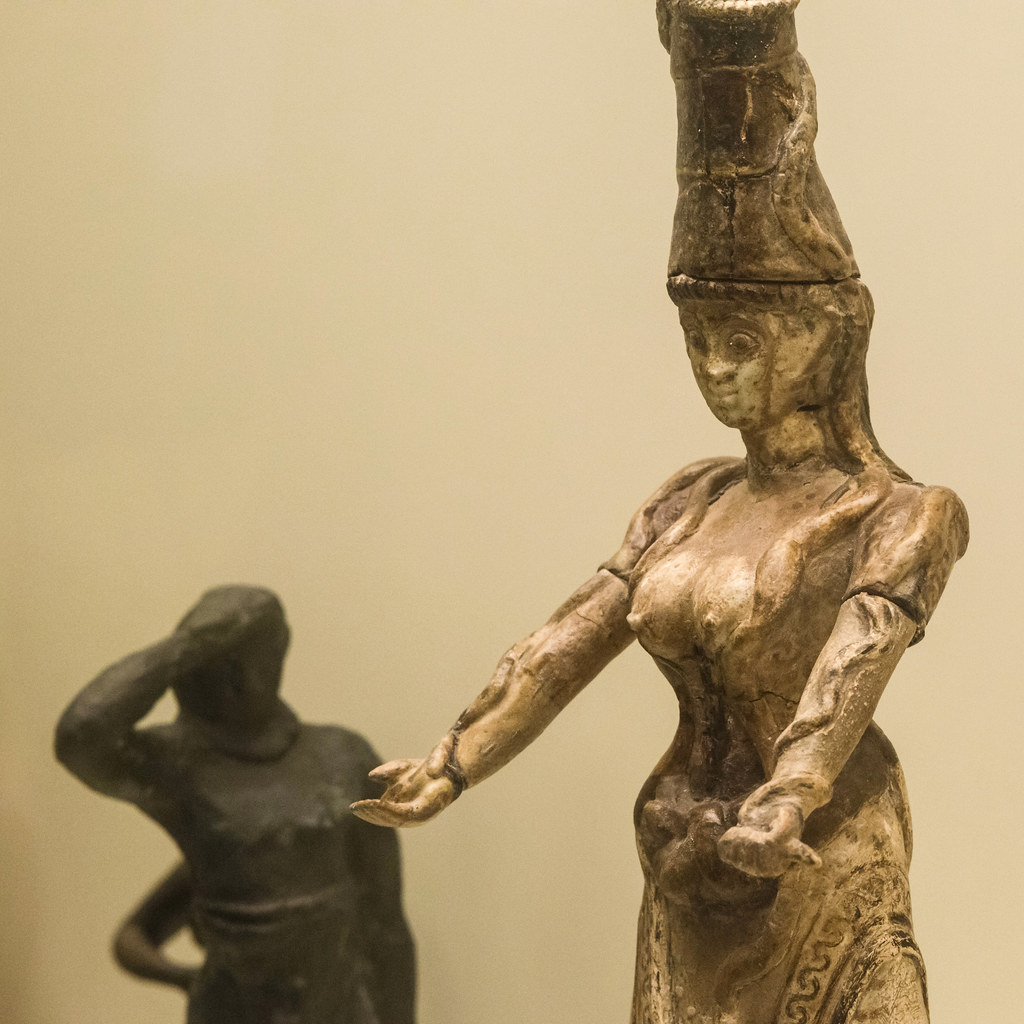
THE VENUS FIGURINES
The oldest known figurative sculpture of a human being is a goddess. The Venus of Hohle Fels—mammoth ivory, six centimeters tall, discovered in 2008 in the Swabian Jura—dates to approximately 40,000 years before the present. It has exaggerated breasts and vulva, no head (replaced by a suspension ring for wearing as a pendant), and no feet.1
Over two hundred Venus figurines are known across Eurasia, from the Pyrenees to Lake Baikal, spanning roughly 30,000 years. The Venus of Willendorf (c. 30,000–25,000 BCE, Naturhistorisches Museum, Vienna) is the most famous: 11.1 centimeters of limestone, with elaborate braided hair, no facial features, pronounced breasts and abdomen.2 The Venus of Dolní Věstonice (c. 29,000–25,000 BCE) is the oldest known ceramic artifact in human history.
The consistency of form across this vast geographic and temporal range—exaggerated female sexual characteristics, frequent facelessness, absence of feet—constitutes the single longest continuous artistic tradition in the human record. Peter Ucko warned against unwarranted inference; McCoid and McDermott proposed the figurines were self-portraits by pregnant women.3 But the counterargument, articulated most forcefully by Marija Gimbutas and Joseph Campbell, is that the sheer persistence of the same form across 30,000 years and thousands of miles cannot be explained as coincidence or utilitarian self-portraiture.4
Even if each individual figurine’s purpose is debated, the pattern itself is the evidence. No comparable male figurative tradition exists for this period. The first 30,000 years of human representational art are overwhelmingly female.
THE PRIMORDIAL WATERS
Genesis 1:2 opens with darkness upon the face of Tehom (תְהוֹם)—the Deep. Tehom is cognate with Akkadian Tiamat, the primordial salt-water goddess of the Enūma Eliš. The primordial state in the Babylonian creation epic is darkness and watery abyss: “Primordial Apsu the Begetter, and Mummu Tiamat, She Who Bore them All—their waters commingling as a single body.”5
Marduk’s killing of Tiamat and splitting of her body to form heaven and earth is the mythic encoding of a patriarchal revolution: the Mother’s body becomes raw material for the Father’s construction project. What Genesis suppresses, the Gnostic texts preserve. “On the Origin of the World” (NHC II,5) states: “He hated his father, the darkness, and his mother, the abyss.” Darkness is the Father. The Abyss—Tehom, Tiamat—is the Mother.6
Michael C. Astour, in Hellenosemitica (1965), demonstrated that the name Membliaros—borne by the island of Thera in Herodotus—derives from the West Semitic phrase mém-bli-ʾōr: “waters without light.”7 The island that exploded in c. 1600 BCE, triggering the Bronze Age collapse of Minoan civilization, bore a name encoding the oldest cosmogonic formula in the Near East.
| Tradition | First Principle | Term |
|---|---|---|
| Babylonian | Primordial waters | Tiamat + Apsu |
| Hebrew | The Deep + Darkness | תְהוֹם + חֹשֶׁךְ |
| Orphic | Night (darkness) | Νύξ (Nyx) |
| Vedic | Waters | Āpas |
| Zoroastrian | Waters + Fire | Apas + Atar |
| West Semitic | Waters without light | מם־בלי־אר (Membliaros) |
THE YOUNGER DRYAS
At approximately 12,800 years before present, global temperatures plunged by 7–8°C in a matter of decades, initiating a 1,200-year cold snap called the Younger Dryas. Firestone, West, and Kennett (2007) presented evidence for a cosmic airburst or impact over the Laurentide Ice Sheet: magnetic microspherules, nanodiamonds, iridium, melt glass, and a continent-wide “black mat” layer.8 Petaev et al. (2013) confirmed a hundredfold platinum spike in the GISP2 Greenland ice core at the same horizon.9
The debate remains active. Holliday et al. (2023) published a comprehensive critique listing persistent flaws in the impact hypothesis; Sweatman, Powell, and West responded with a counter-rebuttal in 2024.10 The geological evidence for a catastrophic event at 12,800 BP is stronger than the specific mechanism proposed to explain it.
Post-glacial sea level rose approximately 120–130 meters between the Last Glacial Maximum and 6,000 BCE. The majority of human settlements in every era are coastal. This means the archaeological record for the entire Mesolithic along former coastlines is underwater and largely unrecoverable.11 Doggerland, Sundaland, the Persian Gulf Oasis—inhabited landscapes now beneath the sea. As Gaffney noted: “There are no known archaeological settlement sites from any period anywhere in the world located more than eight miles offshore”—not because they did not exist, but because they cannot be reached.
Göbekli Tepe—excavated by Klaus Schmidt from 1995 to 2014, T-shaped limestone pillars up to 5.5 meters tall and 10 tons, built by hunter-gatherers before agriculture, pottery, or settled villages—dates to immediately after the Younger Dryas catastrophe.12 Whether or not Pillar 43 (the “Vulture Stone”) encodes a date stamp for the event, the site testifies that complex, organized societies with sophisticated astronomical knowledge existed earlier than the standard model predicted.
Every major civilization preserves a flood narrative: Sumerian (Ziusudra), Babylonian (Utnapishtim), Hebrew (Noah), Greek (Deucalion), Hindu (Manu), Hopi (Third World destruction by water), Chinese (Great Flood of Gun-Yu), Mesoamerican (Aztec Fourth Sun). The universality of this motif is the empirical foundation for “antediluvian”: before the flood.
THE GOLDEN AGE OF KRONOS
Jane Ellen Harrison, in Themis (1912), argues that Kronos was originally an Eniautos-Daimon(ἐνιαυτός δαίμων)—a Year-Spirit, a vegetation deity embodying the annual agricultural cycle of growth, death, and renewal.13 The sickle (ἅρπη) he carries was originally a harvest implement. Its repurposing as the weapon of castration against Ouranos is a later mythological reinterpretation: the agricultural tool transformed into a weapon of cosmic violence when patriarchal Olympian religion supplanted the older chthonic tradition.
The Kronia, an Athenian harvest festival held on the 12th of Hekatombaion, preserved the memory: master-slave role reversal, social egalitarianism, and the recall of a mythical Golden Age when hierarchical and predatory relationships were nonexistent.14 In Lucian’s Saturnalia, Kronos himself rejects the child-eating tradition, claiming he peacefully abdicated and still resumes rulership for seven days each year “to remind humanity of the plenteous, toil-free and luxuriant life they enjoyed under his reign.”
Hesiod’s Works and Days (c. 700 BCE) opens the Five Ages sequence with the Golden Race, who lived in the time of Kronos “when he was reigning in heaven” (109–126). The Hindu tradition preserves the same structure: a Satya Yuga of maximum virtue, declining through four ages to the present Kali Yuga. The convergence across Indo-European traditions is not the product of a single source but of a shared memory: something was lost.
THE DEMONIZATION PATTERN
The pattern is invariant across traditions: agricultural, maternal, and chthonic deities become demons when patriarchal religions take over. The harvest tool becomes a murder weapon. The mother goddess becomes a devourer of children. The festival of equality becomes a memory of chaos.
| Original Deity | Original Function | Demonized Form |
|---|---|---|
| Kronos | Harvest god, Year-Spirit | Child-eating Titan |
| Ba’al Hammon | Lord of fertility, vegetation | Moloch, child-sacrifice idol |
| Tanit | Great Goddess of Carthage | Handmaiden of sacrifice |
| Asherah / Athirat | Mother of the gods | Banned foreign idol |
| Tiamat | Primordial salt-water creatrix | Chaos dragon slain by Marduk |
| Eve / Ḥawwāh | Serpent-goddess, Mother of all living | Mortal temptress, cause of the Fall |
The Carthaginian case is the most instructive. The literary sources accusing Carthage of child sacrifice derive entirely from enemies of Carthage: Kleitarchos, Diodorus Siculus, Plutarch.15 No archaeological correlate for the bronze child-eating statue described by Kleitarchos has ever been found. Schwartz et al. (2010) studied 540 individuals from the Carthage tophet and found that 38% died before or during childbirth—a demographic profile consistent with a sacred cemetery for natural infant deaths, not systematic sacrifice.16
The Punic inscriptions use the term mlk (vocalized as molk). The presence of animal substitution (mlk ʿmr, “offering of a lamb”) indicates the normative was not human. Maimonides—the greatest halakhic authority in Jewish history—reads “passing through the fire” in Mishneh Torah (Hilkhot Avodah Zarah 6:3) as the child being carried over flame, not burned in it: “It is not that he burns him to Molech... this form of worship involved merely passing.”17 In the Guide for the Perplexed (III:37), he calls the rite “a trifling and a light thing” and notes midwives in his own 12th-century North Africa still swinging newborns over incense smoke—a surviving trace of the purificatory gesture.
The typical tophet inscription reads: “To Lady Tanit, Face of Ba’al, and to Lord Ba’al Hammon: that which [Name] vowed; because he heard his voice, he blessed him.” The dead child is never mentioned. The monument is a thank-offering. The votive acclamation—ḥê Tanit, ḥê Ba’alat—means “Hail Tanit, Hail the Lady,” where ḥê derives from the Semitic root ḥ-y-h, “to live.” A life-wish, not a death invocation.18
“The first 30,000 years of human representational art are overwhelmingly female.
THE TOPONYMIC FOSSILS
Four place-name etymologies encode the Minoan-Semitic substrate in geography itself. These are not coincidences. They are the fossils of a shared Mediterranean religious vocabulary, preserved in place-names after the theology was suppressed.
Knossos → Knesset (K-N-S). The consonantal skeleton K-N-S links the Minoan palace Κνωσός with Hebrew כְּנֶסֶת (knesset, “assembly, gathering”). If the Minoan palace functioned as an assembly hall—a center of administration, redistribution, and ritual gathering, which the Linear B evidence confirms—then the Hebrew knesset preserves in its name the memory of the Knossian institution it inherited.19 In Kabbalistic theology, Knesseth Yisrael (כנסת ישראל) became a personified feminine divine entity identified with the Shekhina. Patai documents that she “came very close to being identified with the Knesseth Yisrael, the personified, female Community of Israel.”20 The Zohar (I:33b, II:135a, III:19a) makes the theology explicit: wherever there is a Kenishta (כְּנִישְׁתָּא), the Shekhinah dwells.
Potnia Daburinthoio → Devir (D-B-R). Linear B tablet Gg 702 from Knossos reads: da-pu₂-ri-to-jo po-ti-ni-ja me-ri—“To the Mistress of the Labyrinth: honey.”21 The Linear B form da-pu-ri-to preserves a consonantal skeleton D-P/B-R-T that maps onto the Semitic root D-B-R. The Devir (דְּבִיר) is the Holy of Holies, the innermost sanctuary of the Temple (1 Kings 8:6). If the labyrinth is etymologically a “place of the D-B-R,” then the Potnia Daburinthoio is the Ba’alat ha-Devir: the Mistress of the Holy of Holies.22
Athirat → Thera (Th-R). The goddess אתרת (Athirat, Ugaritic rbt ʾaṯrt ym, “Lady Athirat of the Sea”)—consort of El, mother of the seventy gods at Ugarit—gave her name to the island Θήρα via aphaeresis: the loss of initial unstressed vowels in Semitic-to-Greek borrowing. This process is confirmed by the Çineköy inscription proving Akkadian Aššur → Greek Syria.7 The island bore both the name of the primordial waters (Membliaros) and of the Sea Goddess (Athirat).
| Toponym | Root | Meaning | Connection |
|---|---|---|---|
| Knossos | K-N-S | Assembly | → Knesset (כנסת) |
| Daburinthoio | D-B-R | Inner sanctum | → Devir (דְּבִיר) |
| Thera | Th-R | The island | ← Athirat (אתרת) |
| Membliaros | M-M-B-L-ʾ-R | Waters without light | Cosmogonic formula |
CONTEMPORARY SIGNAL
Where other eschatological traditions provide a script for the current war—Daniel’s ram as Iran, the 1QM War Scroll’s Sons of Light, Frashokereti’s cosmic renovation—the Antediluvian tradition provides context. It is the longest-running pattern recognition available to human intelligence. The signal: this has happened before.
Every civilization that achieves technological sophistication and uses it for warfare destroys itself. The Hopi Third World built flying shields and used them for war. The Vedic kalpas record the same pattern across cosmic time. The Younger Dryas evidence suggests a catastrophic reset at the peak of the last cycle.
Through the Antediluvian lens, the Iran-US war represents two patriarchal systems colliding—neither representing the older tradition they both suppressed. Iranian Zoroastrian-Islamic civilization and American Judeo-Christian civilization are both post-Goddess constructions. Anahita, Athirat, Tanit—the goddess tradition is the substrate they share and deny.
The scholarly chain supporting this reading spans over 160 years: Bachofen (1861) → Morgan (1877) → Engels (1884) → Harrison (1912) → Campbell (1949) → Gordon (1957) → Astour (1965) → Gimbutas (1974) → Eisler (1987). Gimbutas’s Kurgan Hypothesis—that pre-Indo-European “Old Europe” was goddess-centered, matrilineal, and egalitarian before steppe invasion—has been vindicated by ancient DNA studies confirming massive Yamnaya migration with male-biased replacement of Y-chromosome lineages.23
Shawna Dolansky, writing in Bible Odyssey, captured the Eden narrative’s function: “In its ancient context, Eden was about the fall of the goddess, not the ‘fall of man.’”24 William Dever demonstrated that inscriptions from Kuntilet Ajrud reading “Yahweh and his Asherah” prove the goddess was worshipped alongside Yahweh in Israel until the Deuteronomistic reform suppressed her.25
The Strait of Hormuz—named for Hormozd, the Avestan form of Ahura Mazda, whose mazdā is grammatically feminine—carries the theological geography of the Antediluvian tradition into the present. The chokepoint through which the world’s oil flows bears the name of the Lord of Light. The goddess is underneath the name. She has always been underneath the name.
SOURCES
- Conard, N.J. “A female figurine from the basal Aurignacian of Hohle Fels Cave.” Nature 459 (2009): 248–252.
- Antl-Weiser, W. Die Frau von W.—Die Venus von Willendorf (Vienna: Naturhistorisches Museum, 2008).
- Ucko, P.J. Anthropomorphic Figurines of Predynastic Egypt (1968). McCoid, C.H. & McDermott, L. “Toward Decolonizing Gender,” American Anthropologist 98.2 (1996): 319–326.
- Gimbutas, M. The Language of the Goddess (Harper, 1989). Foreword by Joseph Campbell: “a first decipherment of the fundamental mythology of the whole Neolithic.”
- Lambert, W.G. & Millard, A.R. Atra-ḫasīs: The Babylonian Story of the Flood (Oxford, 1969). Foster, B.R. Before the Muses: An Anthology of Akkadian Literature, 3rd ed. (2005).
- “On the Origin of the World” (NHC II,5), trans. Bethge & Layton, in Robinson (ed.) The Nag Hammadi Library (Harper, 1990).
- Astour, M.C. Hellenosemitica (Brill, 1965), pp. 145–146. “Mém-bli-ʾōr: waters without light.”
- Firestone, R.B. et al. “Evidence for an extraterrestrial impact 12,900 years ago.” PNAS 104(41): 16016–21, 2007.
- Petaev, M.I. et al. “Large Pt anomaly in the Greenland ice core.” PNAS 110(32): 12917–20, 2013.
- Holliday, V.T. et al. Earth-Science Reviews 247: 104502 (2023). Sweatman, M.B. et al. Earth-Science Reviews 258: 104961 (2024).
- Lambeck, K. et al. “Sea level and global ice volumes.” PNAS 111(43), 2014. Gaffney, V. et al. Europe’s Lost World: The Rediscovery of Doggerland (CBA, 2009).
- Schmidt, K. Göbekli Tepe: A Stone Age Sanctuary in South-Eastern Anatolia (ex oriente, 2012). Sweatman, M.B. & Tsikritsis, D. “Decoding Göbekli Tepe with Archaeoastronomy.” MAA 17(1): 233–250, 2017.
- Harrison, J.E. Themis: A Study of the Social Origins of Greek Religion (Cambridge UP, 1912), chs. VII–VIII.
- Burkert, W. Greek Religion (Harvard UP, 1985), p. 231. Hansen, W. Ariadne’s Thread (Cornell UP, 2002), pp. 385, 391.
- López-Ruiz, C. Phoenicians and the Making of the Mediterranean (Harvard UP, 2021). Ribichini, S. Poenus Advena: Gli dei fenici e l’interpretazione classica (CNR, 1985).
- Schwartz, J.H. et al. “Skeletal Remains from Punic Carthage Do Not Support Systematic Sacrifice of Infants.” PLOS One 5.2 (2010): e9177.
- Maimonides, Mishneh Torah, Hilkhot Avodah Zarah 6:3. Guide for the Perplexed III:37, trans. Friedlander (1903). Talmud Bavli, Sanhedrin 64b.
- Xella, P. “‘Tophet’: An Overall Interpretation,” in Studi Epigrafici e Linguistici 29–30 (2013): 259–281. Fantar, M.H., Institut National du Patrimoine, Tunis.
- Gordon, C.H. “The Decipherment of Minoan.” Natural History 72 (1963). Astour, Hellenosemitica (1965).
- Patai, R. The Hebrew Goddess (KTAV, 1967), ch. 4. Zohar I:33b, II:135a, III:19a.
- Ventris, M. & Chadwick, J. Documents in Mycenaean Greek (Cambridge UP, 1956). Knossos tablet Gg 702. Faure, P. “Fonctions des cavernes crétoises,” BCH 88 (1964): 167.
- Plassmann, T. “The Semantics of DBR.” CBQ 4/2 (1942): 119–132. Lawler, L. “The Name Melissa,” Names (ANS).
- Haak, W. et al. Nature 522 (2015). Allentoft, M.E. et al. Nature 522 (2015). Gimbutas, M. The Civilization of the Goddess (Harper, 1991). Eisler, R. The Chalice and the Blade (Harper, 1987).
- Dolansky, S. “A Goddess in the Garden?” Bible Odyssey (2015). Doukhan, A. “Eve and the Goddess Innana.” Religions 15:8 (2024).
- Dever, W. Did God Have a Wife? (Eerdmans, 2005). Kuntilet Ajrud inscriptions: “Yahweh and his Asherah.”