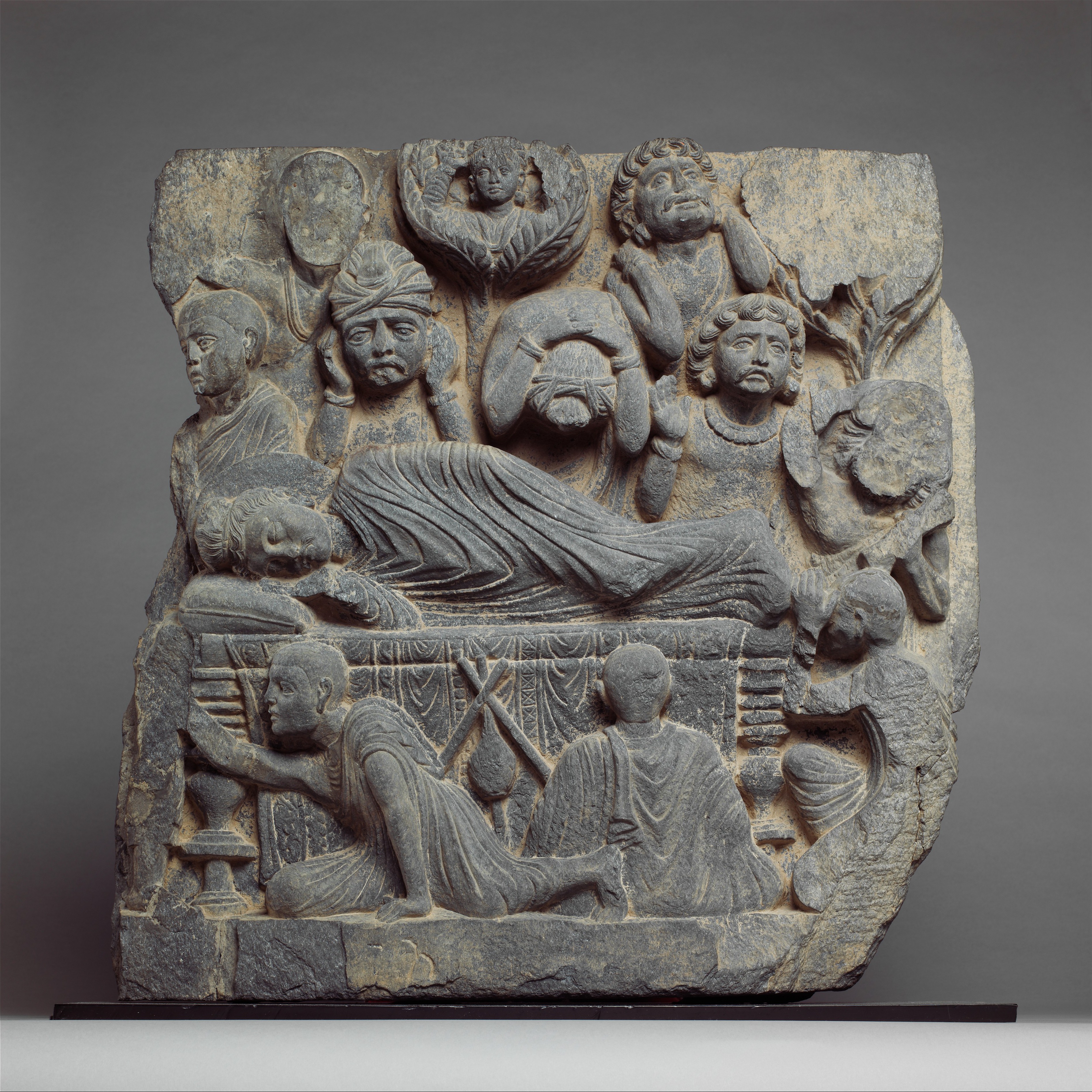
THE MAITREYA-MITHRA CHAIN
Maitreya (Sanskrit: maitreyaḥ) derives from maitrī, “loving-kindness,” from mitra, “friend.” The name is cognate with the Indo-Iranian deity Mitra (Vedic) and Mithra (Avestan)—the god of contracts, friendship, and cosmic order. The shared root is Proto-Indo-Iranian *mitra-, “binding, contract, friend.”1
This is the linguistic thread connecting Buddhist eschatological hope to Zoroastrian soteriology. The earliest canonical reference appears in the Cakkavatti-Sīhanāda Sutta (Dīgha Nikāya 26): human lifespan declines through moral decay to ten years, then reverses; when it reaches 80,000 years, Metteyya appears as the next fully enlightened Buddha.2
In Gandharan art (1st–4th centuries CE, modern northwest Pakistan), Maitreya was the most popular bodhisattva alongside Gautama. The Kushan Empire sat at the geographic crossroads where Zoroastrian, Buddhist, and Hellenistic traditions converged. C.P. Tiele wrote: “No one who has studied the Zoroastrian doctrine of the Saoshyants can fail to see their resemblance to the future Maitreya.”3
The Zoroastrian Saoshyant (saošyant, “one who brings benefit”) appears at the end of the 12,000-year cycle to defeat druj (the Lie) and inaugurate Frashokereti—the eternal renovation. The structural parallel with Maitreya is exact: a future savior appears at the nadir of cosmic decline to restore truth. Whether this reflects direct transmission, shared Proto-Indo-Iranian inheritance, or convergent response to agricultural cycles remains debated. David Alan Scott points to significant iconographic differences; Przyluski and Lamotte argued for Iranian influence. The middle position: both draw from a shared substrate predating the Iranian-Indic divergence around 2000 BCE.4
THE KALI YUGA
Hindu cosmology operates in four ages of progressive decline. The Satya Yuga (truth, righteousness, no disease—the bull of dharma stands on four legs) gives way to Treta, Dvapara, and finally Kali—the age of strife, where dharma limps on a single leg. The Kali Yuga began traditionally on the midnight of 17/18 February 3102 BCE. At 432,000 solar years, humanity is approximately 5,128 years in—barely begun.5
| Yuga | Solar Years | Dharma | Character |
|---|---|---|---|
| Satya | 1,728,000 | 4 legs | Truth, no disease |
| Treta | 1,296,000 | 3 legs | Virtue diminishes by ¼ |
| Dvapara | 864,000 | 2 legs | Virtue halved |
| Kali | 432,000 | 1 leg | Strife, ignorance, degradation |
The signs from the Bhāgavata Purāṇa (Book 12) and Mahābhārata: rulers become unreasonable and levy crushing taxes. Truth, cleanliness, tolerance, and mercy diminish. Wealth alone determines status. Sacred texts are disregarded; ascetics take to commerce. Lust becomes the sole bond between men and women.6
KALKI, THE FINAL AVATAR
Kalki (from kalka, “impurity”) is the tenth and final avatar of Vishnu. Born to Vishnuyashas and Sumati in Shambhala—which is also where Maitreya is prophesied to reign as king, a Hindu-Buddhist convergence point of the first order—Kalki rides a white horse named Devadatta, wielding the sword Nandaka, to destroy the wicked and inaugurate the next Satya Yuga.7
| Feature | Saoshyant | Maitreya | Kalki |
|---|---|---|---|
| Role | Final savior | Future Buddha | Final avatar |
| Appears when | End of 12,000-year cycle | Dharma forgotten | End of Kali Yuga |
| Destroys | Druj (the Lie) | Ignorance | The Kali age |
| Result | Frashokereti | New golden age | New Satya Yuga |
THE MAITREYA REBELLIONS
In China, eschatological expectation has historically been the language of political rebellion against perceived illegitimate rule. The Three Ages of the Dharma (Mòfǎ 末法, the “Latter Day of the Law”) provided the framework: when the current regime embodies cosmic decline, its overthrow becomes a spiritual duty.8
The most consequential case: the Red Turban Rebellion of 1351–1368. Led by Han Shantong of the White Lotus Society under Maitreya’s banner, it overthrew the Yuan Dynasty and established the Ming. Zhu Yuanzhang, who rose from the Red Turbans, founded a dynasty that ruled China for 276 years. A messianic Buddhist movement toppled an empire.9
The pattern repeats: three Sui Dynasty uprisings (610–613), Tang Dynasty rebellions, the Song-era Wang Ze seizure of Beizhou (1047), the second White Lotus Rebellion against the Qing (1796–1804), and the Boxer Rebellion (1899–1901) with White Lotus influence.
In China, the announcement that the cosmic cycle has reached its nadir is a declaration of political illegitimacy.
The CCP has secularized this framework, but the cultural substrate persists. Falun Gong recapitulates the pattern—heterodox salvation religion clashing with the state, explicitly invoking cosmic cycles and the degradation of dharma. If the CCP’s mandate is perceived to weaken through the economic consequences of the Hormuz closure, the historical pattern predicts religious-political movements will surface using eschatological vocabulary.10
“Whenever righteousness declines and unrighteousness prevails, I manifest myself.
THE TRADITIONALIST DIAGNOSIS
René Guénon (1886–1951)—born in Blois, initiated into Sufism c. 1910, converted to Islam as Sheikh Abd al-Wahid Yahya, lived in Cairo from 1930 until death—diagnosed modernity as the terminal phase of the Kali Yuga. In The Reign of Quantity and the Signs of the Times (1945), he argued that the modern world’s descent from quality to quantity is the age’s defining signature. This is not a moral judgment. It is an ontological one: the modern world is further from the source of being.11
The Kali Yuga, the Iron Age, the End of Days, Mòfǎ, the Wolf Age—Guénon argued that all authentic traditions converge on the same diagnosis. Not because they borrowed from each other, but because they all perceive the same cosmic reality from different vantage points. Dissolution is not failure; it is the final phase of a process that makes the next Satya Yuga possible.
Guénon’s influence runs through Seyyed Hossein Nasr’s entire philosophical project. Nasr, an Iranian-American philosopher, represents the Zoroastrian-Islamic-Traditionalist synthesis. Iran, in this reading, is not merely a state defending territory—it is a civilization preserving sacred knowledge through the final phase of a cosmic cycle.12
CONTEMPORARY SIGNAL
None of these traditions predict a specific Iran-US war. Eschatological frameworks are diagnostic, not predictive. Their power lies in pattern recognition across civilizations: three independent traditions, developed millennia apart on different continents, converge on the same diagnosis of the current age.
India’s positioning as a non-aligned power—sitting at Iran’s Hormuz table while maintaining US relations—reads differently through the yuga framework. India positions itself as the civilization that diagnosed the Kali Yuga millennia ago. It does not need the Abrahamic traditions to tell it the age is dark. Pragmatic engagement with both sides represents civilizational patience: the war is a symptom; India’s role is not to fight on either side but to preserve dharma through the dissolution.13
The convergence itself is the signal. Not because the prophecies are being “fulfilled”—but because the condition they describe is recognizable to anyone who is recording rather than narrating.
SOURCES
- Proto-Indo-Iranian *mitra-. Thieme, P. “Mitra and Aryaman,” TAPS NS 47.3 (1957).
- Cakkavatti-Sīhanāda Sutta (DN 26). Buddhavaṃsa Ch. 28. Maitreyavyākaraṇa.
- Tiele, C.P. The Religion of the Iranian Peoples (English tr., 1912). Gandharan Maitreya iconography: Kushan period, 30–375 CE.
- Przyluski, J. (Iranian influence thesis). Scott, D.A. (iconographic skeptic). Boyce, M. A History of Zoroastrianism I (1975), pp. 234–35, 281–293. Malandra, W. “SAOSYANT,” Encyclopaedia Iranica (2000).
- Āryabhaṭa, Āryabhaṭīya (499 CE). Kane, P.V. History of Dharmaśāstra. Sri Yukteswar, The Holy Science (1894) — alternative 24,000-year cycle.
- Bhāgavata Purāṇa Book 12. Mahābhārata, Vana Parva CLXXXIX.
- Kalki Purāṇa (c. 18th c., per Rocher, The Purāṇas, 1986). Viṣṇu Purāṇa 5.38.8. Hiltebeitel, A. Dharma (2011).
- Nattier, J. Maitreya typology (here/there × now/later). Three Ages: 正法 → 像法 → 末法.
- Red Turban Rebellion (1351–1368). Han Shantong, White Lotus Society. Zhu Yuanzhang → Ming Dynasty.
- Sponberg, A. & Hardacre, H. (eds.) Maitreya, the Future Buddha (Cambridge UP, 1988). Falun Gong: Li Hongzhi, Zhuan Falun.
- Guénon, R. La Crise du monde moderne (1927). Le Règne de la quantité et les signes des temps (1945). Sedgwick, M. Against the Modern World (Oxford, 2004).
- Nasr, S.H. Knowledge and the Sacred (1981). Coomaraswamy, A. The Transformation of Nature in Art.
- González-Reimann, L. The Mahabharata and the Yugas (Peter Lang, 2002). Malhotra, R. Being Different (2011).