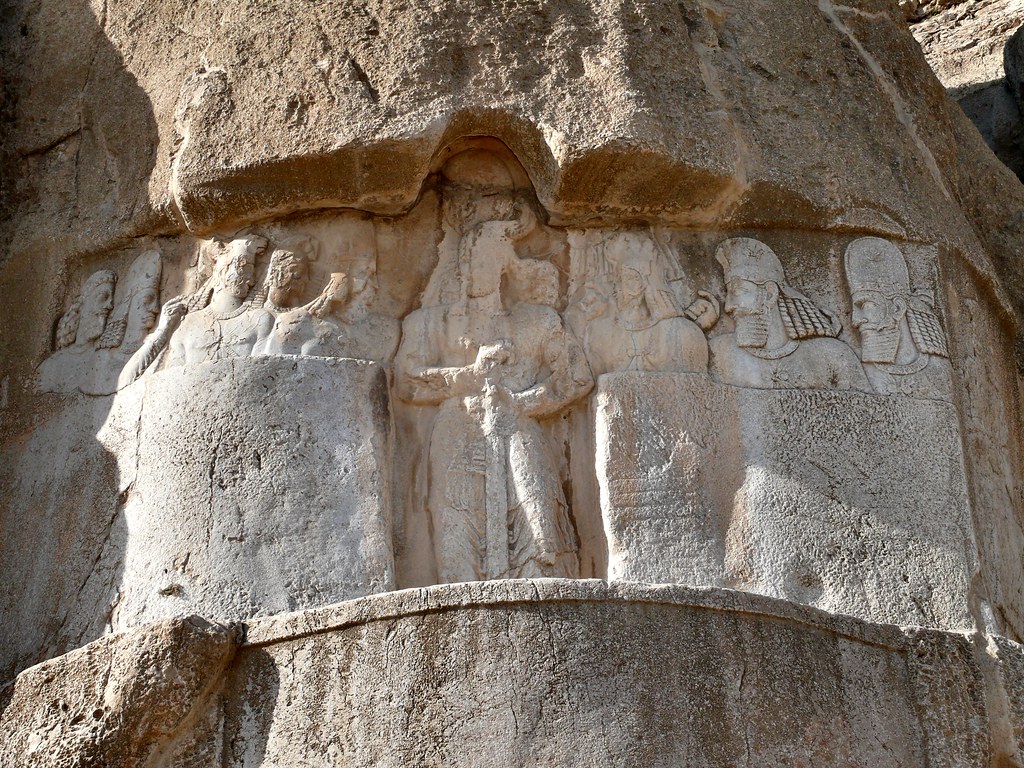
THE ETYMOLOGY
The name “Hormuz” is not arbitrary. It derives, through a documented chain of sound changes spanning three millennia, from Ahura Mazdā—the supreme deity of Zoroastrianism, the religion of the Achaemenid and Sasanian empires that ruled the land on both sides of the strait for over a thousand years.1
The intermediate forms are attested in royal inscriptions, coins, and administrative records. Six Sasanian kings bore the name Hormizd. The settlement of Harmozia was documented by Arrian in the 4th century BCE.2
| Stage | Form | Language / Period |
|---|---|---|
| 1 | Ahura Mazdā | Old Avestan (Gathas, c. 1700–1000 BCE) |
| 2 | Auramazdā | Old Persian (Achaemenid, 550–330 BCE) |
| 3 | Ōhrmazd / Hormazd | Middle Persian (Sasanian, 224–651 CE) |
| 4 | Hormizd | Sasanian royal name (6 kings, 272–632 CE) |
| 5 | Hormuz | New Persian / Arabic (Kingdom of Hormuz, 11th c.–1622) |
| 6 | Strait of Hormuz | Geographic name (~20% of global oil transit) |
The strait bearing this name now handles approximately 20% of global oil consumption—some 18–19 million barrels per day.3 The name came first. The oil came later.
THE LORD AND THE WISDOM
In the compound Ahura Mazdā, the two elements carry different grammatical genders. Ahura(“lord”) is masculine. Mazdā(“wisdom, intelligence”) is feminine. This is standard Avestan morphology, reflected in the Proto-Indo-Iranian reconstruction *mazdhaH (f.), from PIE *mn-s-dhh₁-eh₂, where the -eh₂ suffix marks the feminine.4
“Some writers contend that since in Zarathushtra’s chosen name of God, Ahura Mazda, Ahura is linguistically masculine and Mazda feminine, the prophet even in choosing the name of God has carefully observed the equality of the sexes.”
— Dr. Darius Jahanian, “Women in the Avesta Era,” Iran Chamber Society (2002)
Zarathustra addresses the compound with neuter pronouns on multiple occasions, avoiding gendered personification.4 The naming convention places masculine lordship and feminine wisdom into a single divine identity that the language itself declines to resolve into either category.
The Avestan ahura is cognate with Vedic asura, both from Proto-Indo-Iranian *Hásuras (“lord, powerful one”). In India, asura evolved from a title of divine potency to a word for “demon”; in Iran, ahura remained “supreme god” while daeva became “demon”—the same pair of words, opposite valences.5 Kuiper identifies the pre-Zoroastrian Ahura with Vedic Varuna: both asura/ahura, both guardians of cosmic order (ṛta = asha), both paired with Mitra/Mithra.6
THE TRIAD: AHURA MAZDA, ANAHITA, MITHRA
Prior Achaemenid inscriptions—those of Darius I and Xerxes—invoke only Ahura Mazda. The inscription of Artaxerxes II at Susa (A2Sd, 404–359 BCE) is the first to name all three: “May Ahuramazda, Anahita, and Mithra protect me and my building against evil.”7
| Deity | Function | Domain |
|---|---|---|
| Ahura Mazda | Creator / Sovereign / Wisdom | Sky, cosmic order, truth (asha) |
| Anahita | Waters / Fertility / Purification | All waters, reproduction, sovereignty |
| Mithra | Covenant / Truth / Light / Sun | Contracts, judgment, warfare |
Anahita—full Avestan title Arədvī Sūrā Anāhitā (“Moist, Mighty, Immaculate”)—is assigned the role of guardian of Zarathustra’s seed in Lake Kansaoya, from which the three Saoshyants will be born at the end of history.8 Nabarz (Anahita, Avalonia, 2013) assembled 25+ international scholars for the most comprehensive modern study.
The coins of Hormozd I (r. 272–273 CE)—the Sasanian king who bore the deity’s name—depict investiture scenes with Anahid and Mihr on the reverse.9 The triad was not merely theological. It was political currency.
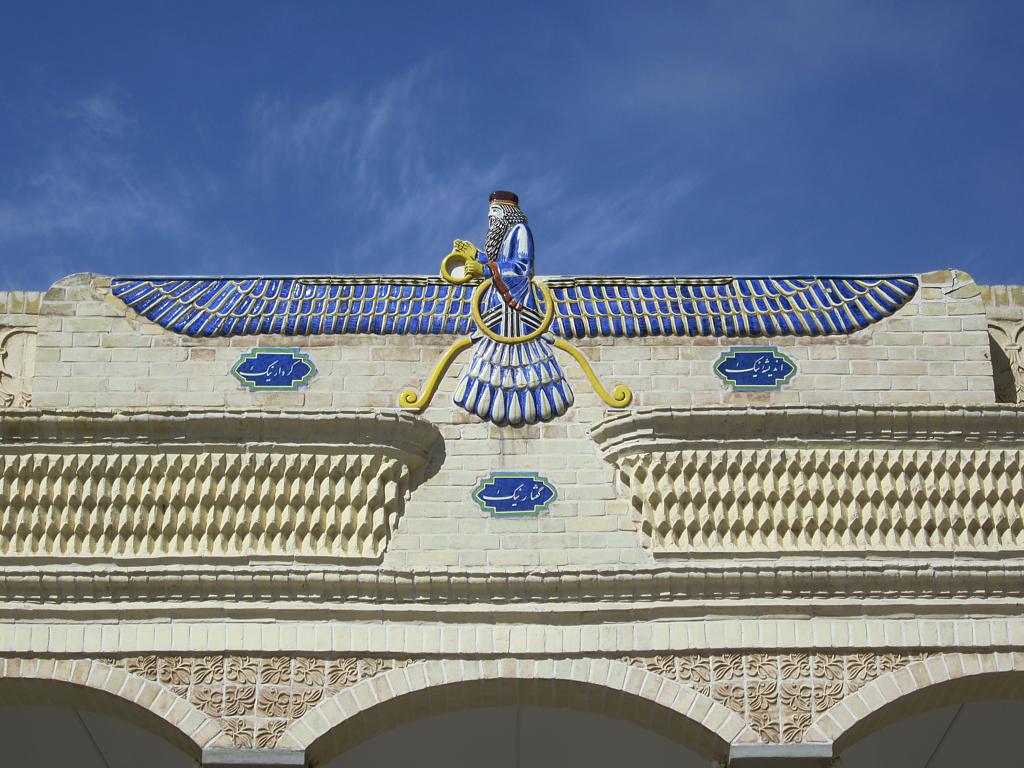
AHURA MAZDA
The Faravahar—winged disc representing the fravashi (guardian spirit). Mazdā is grammatically feminine. At death, the virtuous soul meets the Daena (دین)—its own conscience—as a beautiful maiden at the Chinvat Bridge.10
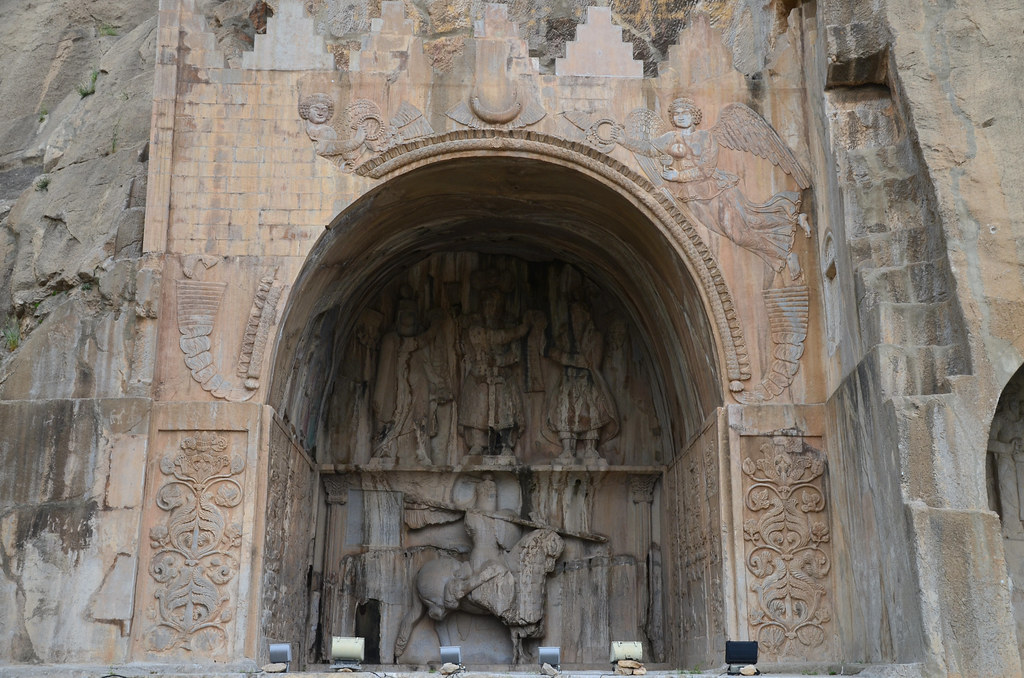
ANAHITA
Taq-e Bostan, Kermanshah. Arədvī Sūrā Anāhitā—guardian of Zarathustra’s seed, from which the Saoshyants will be born. Cognate with Vedic Sarasvati; the Iranian equivalent of Sita—both exemplars of immaculate purity tested by ordeal.11
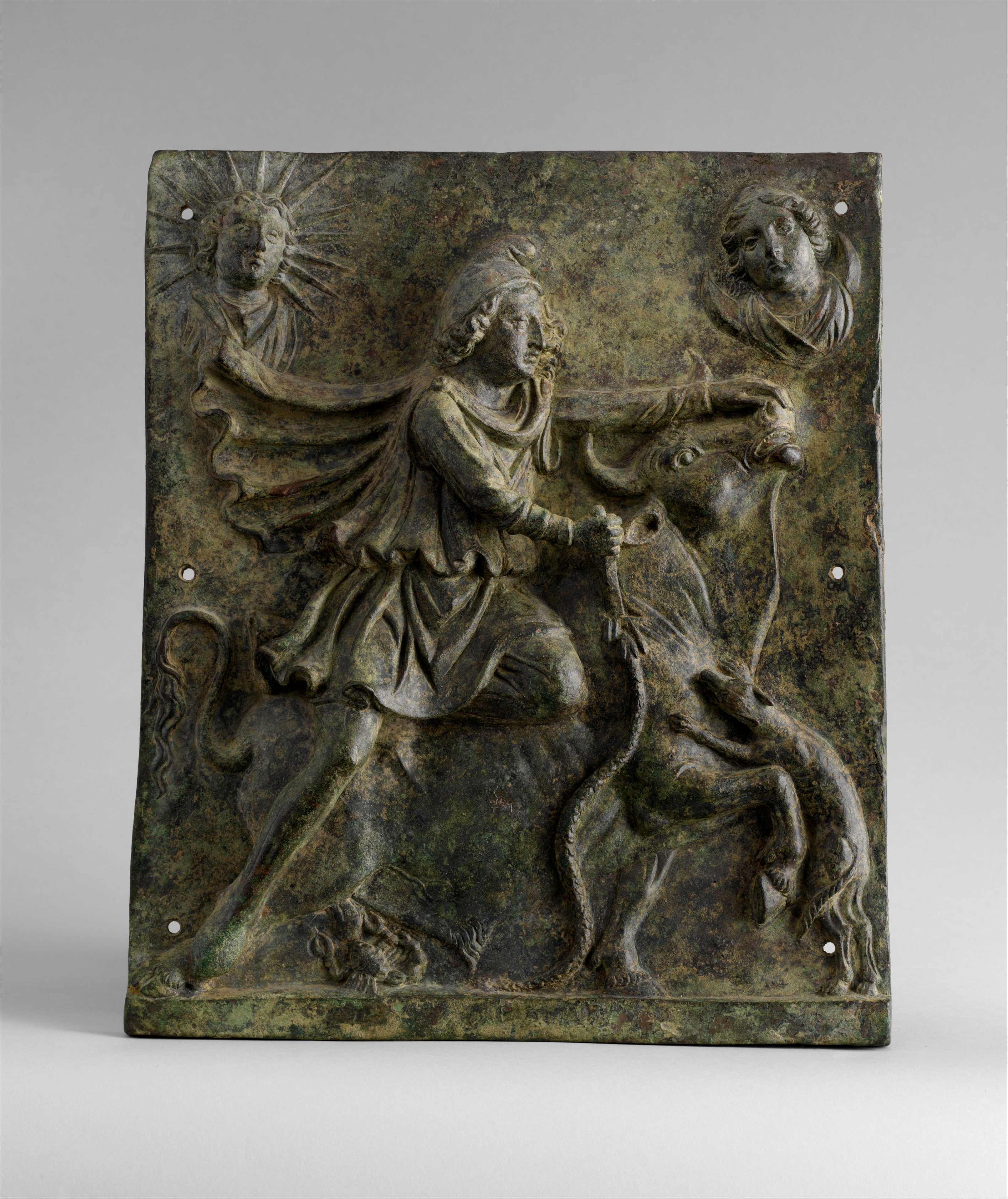
MITHRA
Roman tauroctony (Met Museum, CC0). Iranian Mithra became Roman Mithras—whose underground temples (Mithraea) lie beneath Catholic churches across Rome: San Clemente, Santa Prisca (smashed cult images beneath the church), Santo Stefano Rotondo. Coarelli argued the overlap exceeds chance.12
THE MOTHER-DAUGHTER-SON PARALLEL
A structural pattern appears across Mediterranean and Iranian traditions: a senior generative figure, a young female mediator associated with waters or purity, and a youthful male agent of light or covenant. Whether this reflects common inheritance, transmission, or convergent response to agricultural cycles remains debated. The positions are noted here for comparison.
| Role | Roman | Greek | Canaanite | Zoroastrian |
|---|---|---|---|---|
| Mother | Ceres | Demeter | Athirat | Ahura Mazda (mazdā = fem.) |
| Daughter | Libera | Kore | Anat | Anahita |
| Son | Liber | Kouros / Dionysos | Ba’al / Tammuz | Mithra |
Cicero (De Natura Deorum 2.62) states that Ceres is the mother of Liber and Libera—a family relationship, not merely a cultic grouping.13 Harrison (Themis, 1912) argues the pre-Olympian structure centered on the Great Mother, the Divine Maid, and the Year-Spirit whose death enables seasonal renewal.14 In the Ugaritic Ba’al Cycle (KTU 1.6.II), Anat descends to confront Mot and tears him apart to enable Ba’al’s return—a structural parallel with Kore’s descent.
The Zoroastrian triad is a functional parallel—Mithra does not die and rise, Anahita does not descend to an underworld. But the structural positions are homologous: a senior generative principle (feminine-coded), a young female mediator of purity and water, and a youthful male agent of light and covenant. The architecture of the sacred is consistent.
THE KINGDOM OF ORMUS
The name descended from deity to geography through royal usage. By the medieval period, the Kingdom of Hormuz (11th century–1622) was among the wealthiest trading ports in the world. An Arab proverb recorded: “If all the world were a golden ring, Ormus would be the jewel in it.” Zheng He visited during the Ming treasure voyages. Afonso de Albuquerque captured the island in 1507. Shah Abbas I expelled the Portuguese in 1622 and built Bandar Abbas (“Abbas’s Port”) on the mainland opposite.15
Today Hormuz Island is home to approximately 6,000 people, mostly fishermen. Its red ochre beaches sit atop a salt diapir 600 million years old. The name of the supreme Zoroastrian deity survives in a fishing village.
“The strait is closed. The name remains. Mazdā is feminine.
THE THEOLOGICAL GAP
No major Western newspaper has published an analysis connecting the Zoroastrian naming of Hormuz to the strait’s geopolitical significance. The Islamic Republic does not invoke the pre-Islamic etymology in its public communications. The connection circulates among Parsi diaspora writers and independent essayists.16
“The irony is almost poetic. The modern world’s energy lifeline flows through a channel whose name ultimately traces back to a concept meaning the spirit of wisdom.”
— Adil Minocherhomjee, “The Strait Named After a Spirit” (Substack, March 11, 2026)
The strait is closed. The name remains. The world’s oil supply depends on a passage consecrated to wisdom.
SOURCES
- Shayegan, M.R. “HORMOZD I,” Encyclopaedia Iranica XII.5 (2004): 462–464. “Ōhrmazd in the Sasanian inscriptions, the name of both the king and the supreme deity, from OPers. Auramazdā, Av. Ahura Mazdā.”
- Potts, D.T. “HORMUZ i. PRE-ISLAMIC PERIOD,” Encyclopaedia Iranica XII.5 (2004): 470–471. Toponym Harmozia documented by Arrian, Indica 33.2–3.
- EIA, “World Oil Transit Chokepoints” (2023). ~18–19 million bbl/day pre-war baseline.
- Jahanian, D. “Women in the Avesta Era,” Iran Chamber Society (2002). Kuiper, F.B.J. “Avestan Mazda-,” Indo-Iranian Journal 1 (1957): 86–95.
- Thieme, P. “The ‘Aryan’ Gods of the Mitanni Treaties,” JAOS 80.4 (1960): 301–317. Hale, W.E. Asura in Early Vedic Religion (Motilal Banarsidass, 1986).
- Kuiper, F.B.J. “AHURA,” Encyclopaedia Iranica I.7 (1984): 683–684. “Ahura is clearly the pre-Zoroastrian counterpart of Varuna.”
- Artaxerxes II inscription A2Sd (Susa), in Lecoq, Les inscriptions de la Perse achéménide (1997).
- Boyce, M. “ASTVAT.ERETA,” Encyclopaedia Iranica (1987). Bundahishn XXXV.60. Nabarz, P. (ed.) Anahita: Ancient Persian Goddess and Zoroastrian Yazata (Avalonia, 2013).
- Göbl, R. Sasanidische Numismatik (Braunschweig, 1968), p. 20. Hormozd I coins with Anahid/Mihr on reverse.
- Hadokht Nask (Yasht 22.9), trans. Darmesteter, SBE. The Daena appears as a beautiful maiden to the righteous. See also Arda Viraf Namag.
- Lommel, H. “Anahita-Sarasvati,” Asiatica: Festschrift für F. Weller (1954): 404–413. On the Anahita-Sita parallel: both undergo fire ordeals as proof of immaculate purity (Agni Pariksha / molten metal ordeal, Yasht 19).
- Coarelli, F. “Topografia mitriaca di Roma,” in Bianchi (ed.), Mysteria Mithrae (Brill / L’Erma, 1979): 69–79. Vermaseren & van Essen, Excavations in the Mithraeum of Santa Prisca (Brill, 1965). Guidobaldi, San Clemente (1992).
- Cicero, De Natura Deorum 2.62. Spaeth, B.S. The Roman Goddess Ceres (U. Texas Press, 1996).
- Harrison, J.E. Themis: A Study of the Social Origins of Greek Religion (Cambridge UP, 1912). Mettinger, T.N.D. The Riddle of Resurrection (Almqvist & Wiksell, 2001).
- Kingdom of Hormuz: founded 11th c. as dependency of Kerman Seljuks; relocated to Jarun Island c. 1300. Portuguese conquest 1507/1515 (Albuquerque). Shah Abbas I expelled Portuguese 1622.
- Minocherhomjee, A. “The Strait Named After a Spirit,” Substack (March 11, 2026). Oldfield, A. “Hormuz—Entering the Light Side of God,” Medium (June 30, 2025).